
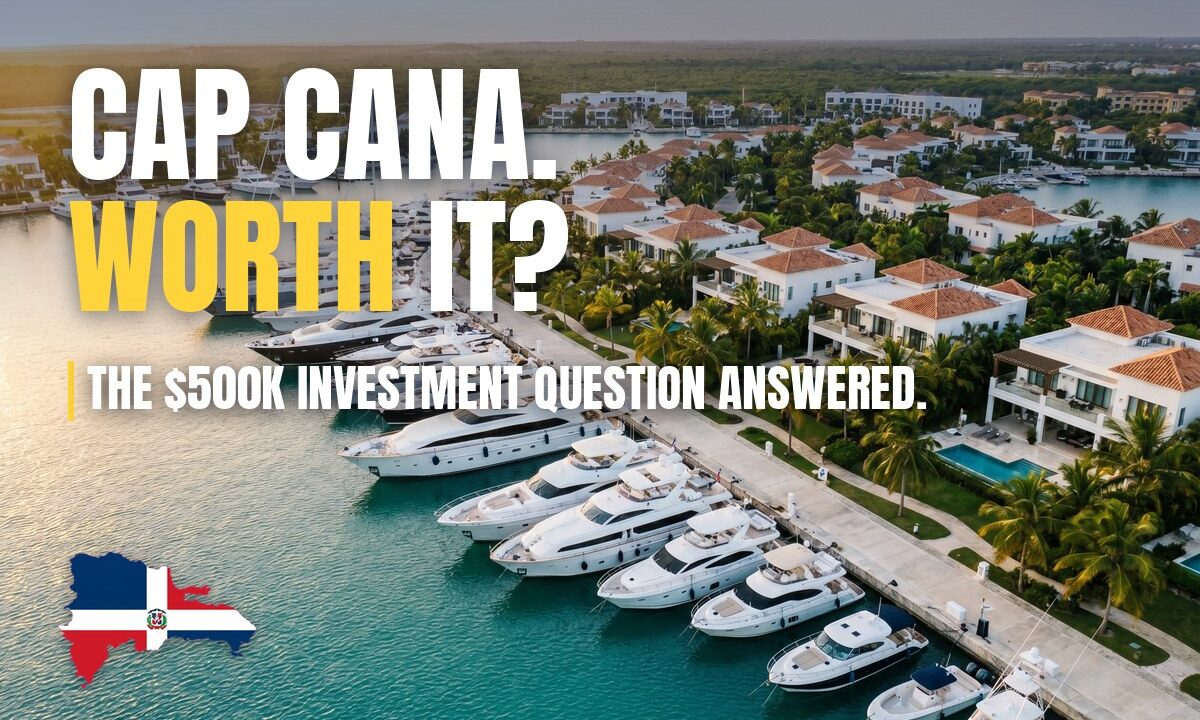
Cap Cana justifies its premium price for ultra-high-net-worth buyers seeking exclusive Caribbean luxury with world-class amenities, marina access, and strong appreciation potential. However, if you’re looking for rental income or broader market exposure, the North Coast offers superior ROI at a fraction of the cost.
What Is Cap Cana?
Cap Cana is the Caribbean’s most exclusive residential and resort development located in Punta Cana on the East Coast of the Dominican Republic. It sits on 3,600 acres of private, gated waterfront property featuring championship golf courses, a 1,000-slip superyacht marina, and ultra-luxury residential estates. Only ultra-high-net-worth individuals (typically $10M+ liquid assets) make up the buyer demographic.
The Financial Reality: Entry Price vs. Value Proposition
Entry-level villas in Cap Cana start at $500,000 but most quality properties range from $750,000 to $2+ million. This represents a 20-30% premium over comparable luxury properties in other Punta Cana neighborhoods like Cocotal or Playa Dorada.
| Metric | Cap Cana | Cocotal Golf Club | North Coast (Sosúa) |
|---|---|---|---|
| Entry Price Range | $500K – $1M+ | $300K – $600K | $150K – $400K |
| Expected Gross Rental Yield | 4-6% | 7-9% | 8-12% |
| Annual Appreciation Rate | 3-5% | 5-8% | 8-14% |
| HOA/Maintenance (Annual) | $8K – $15K+ | $3K – $6K | $1.8K – $3.6K |
| Target Buyer | FatFIRE/Lifestyle | Balanced Investors | ROI-Focused Investors |
Cap Cana’s Exclusive Amenities: What You’re Actually Paying For
- Private Superyacht Marina: 1,000-slip capacity for mega-yachts and luxury vessels. Docking fees run $2-5+ per foot per night, generating yacht owner lifestyle access.
- Jack Nicklaus Championship Golf: Two 18-hole courses designed by golf legends. Membership and play privileges are restricted to property owners and their guests.
- Private Beach Access: Exclusive white-sand beaches. No public access means total privacy for residents.
- 24/7 Gated Security: Armed guards at all entry points. Biometric gate systems and perimeter surveillance.
- Fine Dining and Clubs: On-site restaurants, beach clubs, and private event spaces. These are not publicly available.
- International Airport Proximity: Punta Cana International Airport is 15 minutes away. Direct flights to Miami, New York, and Canada.
Appreciation Potential: Is Cap Cana a Wealth-Building Play?
Cap Cana appreciates at 3-5% annually, which is slower than emerging North Coast markets (8-14%) and even moderate Punta Cana neighborhoods (5-8%). However, Cap Cana buyers are not typically seeking maximum ROI. They are seeking scarcity, exclusivity, and lifestyle wealth preservation.
For a $1 million Cap Cana villa purchased in 2024:
- Conservative Scenario (3% annual): Property worth $1.34M after 10 years. Gain of $340K.
- Moderate Scenario (4% annual): Property worth $1.48M after 10 years. Gain of $480K.
- Best Case Scenario (5% annual + amenity expansion): Property worth $1.63M after 10 years. Gain of $630K.
Compare this to a $250K Sosúa villa appreciating at 10% annually, which would be worth $648K in 10 years (gain of $398K) while generating consistent $2K-$2.5K monthly rental income. The Cap Cana property may hold wealth better long-term, but the Sosúa property generates active income immediately.
Rental Income Reality: Cap Cana vs. Other Markets
Cap Cana properties rent at 4-6% gross yield because they target a niche market: ultra-wealthy vacationing families and executives seeking month-long privacy escapes. The rental season is compressed (December-April), and nightly rates are high ($500-$1,500+) but occupancy is inconsistent.
A $1 million Cap Cana villa might generate:
- 50% occupancy (realistic for ultra-luxury) = $250K annual gross rental income
- Minus management fees (20%) = $200K
- Minus HOA ($10K) and utilities ($6K) = $184K net
- Net Yield: 18.4% before taxes
However, maintaining a $1M villa requires premium property management ($5K-$10K monthly), which is already factored above. Lower occupancy rates (30-40%) would drop your net yield to 8-12%.
The Comparison: Cap Cana vs. Alternative Investments
Cap Cana (Ultra-Luxury Play)
Best for: Ultra-high-net-worth buyers prioritizing lifestyle, privacy, and wealth preservation over cash flow. If your net worth exceeds $25M and Caribbean luxury is a genuine lifestyle choice (not an investment).
Pros: Unmatched exclusivity, strong property preservation value, world-class amenities, direct yacht access, zero public beach crowding.
Cons: Low rental yields (4-6%), slower appreciation (3-5%), massive HOA fees ($8K-$15K annually), niche buyer pool reduces resale liquidity, currency risk for USD-based investors.
Cocotal Golf Club (Balanced Alternative)
Best for: Investors seeking luxury amenities with better ROI. Cocotal offers golf course membership, gated security, and 7-9% rental yields at half the Cap Cana price.
Pros: Better rental yields, lower entry price ($300K-$600K), established buyer community, easier resale liquidity.
Cons: Less exclusive than Cap Cana, more crowded beaches, less yacht culture.
North Coast (Sosúa/Cabarete) (Maximum ROI)
Best for: Investors seeking 8-12% rental yields and strong appreciation (10-14% in select markets). If you want your property to pay for itself and build wealth aggressively.
Pros: Highest rental yields, strongest appreciation, lower entry prices ($150K-$400K), proven Airbnb market, established expat community.
Cons: Less luxury, more tourist crowds, higher tenant management requirements, smaller global buyer pool (vs. ultra-wealthy).
The Hidden Costs of Cap Cana Ownership
Cap Cana’s price tag is the most visible cost, but total cost of ownership tells a different story.
- HOA Fees: $600-$1,500 monthly for luxury estates ($8K-$18K annually). Covers security, beach maintenance, golf course upkeep, and marina operations.
- Property Taxes (IPI): 1% annually on property value. A $1M villa = $10K per year. However, CONFOTUR tax exemption saves $15K over 15 years if you qualify.
- Property Management: If renting out, 20% of gross revenue. On a $250K annual rental income, that’s $50K.
- Maintenance and Repairs: Tropical climate and salt air. Budget $3K-$5K annually for general maintenance.
- Insurance: Property and liability insurance is expensive. Budget $2K-$4K annually for hurricane/flood coverage.
- Capital Improvements: Luxury villas require refreshes every 5-7 years. Budget $50K-$150K for modernization to maintain rental appeal.
Total Annual Carrying Cost for a $1M Cap Cana Villa: $100K-$150K before mortgage payments or income tax.
Best Choice Based on Your Situation
Choose Cap Cana If:
- You have a net worth above $10M and view Caribbean luxury as a lifestyle, not an investment.
- You want a private retreat for personal use 2-4 months per year, with rental income as secondary income.
- You prioritize privacy, yacht access, and exclusivity over maximum ROI.
- You plan to hold for 10+ years and don’t need immediate cash flow.
- You want a Caribbean property that increases in value predictably (3-5% annually) with minimal tenant management stress.
Choose Cocotal Golf Club If:
- You want luxury amenities with better financial returns (7-9% yields).
- You have $300K-$600K and want a balanced lifestyle-plus-income property.
- You want golf course access without the ultra-luxury price tag.
Choose North Coast (Sosúa/Cabarete) If:
- You prioritize cash flow and appreciation (8-14% annually).
- You have $150K-$400K and want a property that pays for itself through rentals.
- You’re building wealth aggressively and don’t mind tenant management.
- You want to maximize return on investment for future liquidity.
Key Entities Explained
CONFOTUR Tax Exemption
Law 158-01 grants 15-year exemptions from the 3% transfer tax and annual 1% IPI for approved tourism projects. Cap Cana properties may qualify, saving owners $15,000+ over the exemption period on a $1M purchase.
What This Means for US and Canadian Buyers
For US Buyers: Cap Cana ownership triggers FIRPTA (Foreign Investment in Real Property Tax Act) requirements. You’ll owe US federal taxes on rental income and capital gains. Consider structuring ownership through a Delaware LLC or Dominican holding company to defer taxes. US citizens cannot escape US tax obligations, but structuring minimizes tax drag.
For Canadian Buyers: Dominican rental income is taxable in Canada under foreign income rules. Cap Cana’s lower yields (4-6%) mean less Canadian tax burden compared to North Coast properties (8-12% yields). Currency fluctuations between CAD and DOP can impact returns. Use a Canadian currency specialist broker to minimize losses on large property purchases.
For Both: Cap Cana offers stability and predictability. The development is controlled, well-managed, and attracts institutional interest. If your primary goal is a stable Caribbean asset (not maximum income), Cap Cana’s premium price pays for that certainty. RealtorDR helps North American buyers structure Cap Cana acquisitions with proper legal frameworks and currency management to maximize after-tax returns.
Frequently Asked Questions
No. Cap Cana’s 4-6% gross yields are lower than market alternatives. If you need monthly rental income, the North Coast (8-12% yields) is a better choice. Cap Cana is best for wealth preservation and luxury lifestyle, not aggressive cash flow.
Slightly. Resale properties (sold by previous owners) may have 5-10% negotiation room. However, properties sold directly by Cap Cana Developers are fixed-price. Don’t expect the aggressive negotiation you’d find on the open North Coast market.
60-180 days for well-priced properties in the $500K-$1M range. Ultra-luxury estates ($2M+) can take 6-18 months due to the smaller buyer pool. Ensure your property is truly “turnkey” and professionally marketed.
No. Cap Cana appreciates at 3-5% annually, while North Coast properties (especially beachfront) appreciate at 8-14% annually. However, Cap Cana properties are more stable and less volatile, which appeals to wealth-preservation buyers.
Cap Cana has been developed for 20+ years and is now fully operational with strong institutional backing. The risk is low but not zero. Diversifying your Dominican real estate across multiple regions (Cap Cana + North Coast) hedges this risk.
Some Cap Cana properties qualify if they are part of CONFOTUR-approved projects. Check with your lawyer to confirm. If eligible, you save $15,000+ over 15 years on transfer tax and annual property tax.
Yes. A self-directed IRA or Solo 401(k) can be used for offshore real estate purchases through a third-party custodian. Cap Cana properties are expensive enough that SDIRA strategies are worthwhile for tax-deferred wealth building.
Approximately $1.2M-$1.5M in carrying costs (HOA, taxes, insurance, maintenance) before any appreciation gains. However, the property also appreciates by $300K-$630K (depending on market), potentially resulting in a net gain of $300K-$630K after expenses.
Key Takeaways
- Cap Cana justifies premium pricing for ultra-wealthy buyers prioritizing lifestyle and privacy over maximum ROI.
- Rental yields are low (4-6%) compared to North Coast alternatives (8-12%), making Cap Cana better for wealth preservation than cash flow.
- Total annual carrying costs ($100K-$150K for a $1M villa) require financial sophistication and sufficient liquidity.
- Appreciation rates (3-5% annually) are slower than North Coast properties but offer more predictable, stable growth.
- For investors seeking maximum returns, Cocotal Golf Club or North Coast properties deliver better ROI at lower entry prices.
- Cap Cana’s exclusive amenities (marina, golf, private beaches) are genuine lifestyle assets, not financial multipliers.